Downsizing in Granada Hills: A Practical Guide
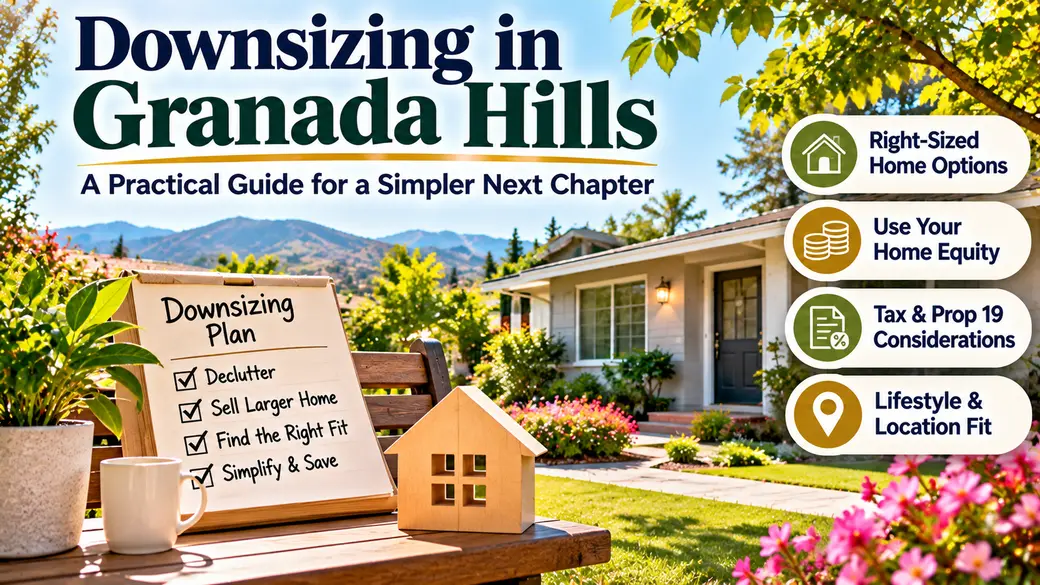
Downsizing in Granada Hills can turn unused square footage into a simpler routine, fewer maintenance demands, and a home that better fits the next stage of life. The key is not merely choosing a smaller property. It is matching the layout, location, carrying costs, and accessibility to how you want to live next. Start by defining what must come with you, what can be released, and how the proceeds from your current home can support the move.
Is Granada Hills a Good Place to Downsize?
Granada Hills can be a sensible place to downsize for owners who want to remain in the San Fernando Valley while reducing daily home responsibilities.
- Tax-base portability: Eligible California homeowners age 55 or older may transfer a qualifying base-year value to a replacement primary residence anywhere in the state, up to three times, subject to program rules. California State Board of Equalization
- Property-tax structure: California's general property-tax levy is limited to 1% of assessed value before voter-approved debt and local charges that can appear on a tax bill. Los Angeles County Assessor
- Smaller-home choices: Condominiums, townhomes, and compact detached homes can reduce exterior upkeep, though association dues and insurance requirements need to be part of the comparison.
- Everyday driving: Homes closer to Chatsworth Street and Devonshire Street may offer a different daily-driving experience than hillside settings, so driveway slope, stair count, parking, and route access deserve attention during tours.
- Lifestyle continuity: Remaining in Granada Hills can preserve familiar routines, nearby parks, local services, and connections with family while reducing the workload of a larger property.
Granada Hills Downsizing by the Numbers
The most useful downsizing figures are the tax and transaction rules that shape net proceeds, rather than a headline price alone. Tax rules and transfer-tax rates below were checked against the linked official sources as of November 2, 2026, and may change.
- Primary-residence gain exclusion: Up to $250,000 for eligible individual filers and up to $500,000 for eligible married couples filing jointly.
- County general levy: 1% of assessed value under Proposition 13, plus applicable voter-approved debt and local charges.
- Proposition 19 transfers: Up to three qualifying base-year-value transfers for homeowners age 55 and older, subject to eligibility, timing, and filing requirements.
- City transfer tax: For property within Los Angeles city limits, the base tax is $2.25 per $500 or fraction thereof, generally described as 0.45%. The calculation rounds the value up to the next $500 increment. Los Angeles Office of Finance
Why People Choose Downsizing in Granada Hills
Downsizing in Granada Hills often works best when a long-held detached home no longer matches the owner's daily needs. A four-bedroom home may include guest rooms, a larger yard, stairs, storage areas, and repair projects that once served a busy household but now require more attention than they return. A smaller condo, townhome, or compact detached home can reduce the number of spaces and systems that need to be managed.
The financial case comes from net equity, not from assuming a fixed gap between a larger house and a smaller residence. In practical terms, owners compare the expected sale proceeds from the current home with the all-in cost of a two-bedroom replacement property, including association dues, insurance, moving, and any updates needed before listing. The result can be more flexibility for retirement reserves, travel, family support, or a lower monthly housing commitment.
California's Proposition 19 can be particularly relevant for eligible owners who have held their Granada Hills home for years. Homeowners age 55 or older may be able to transfer a qualifying taxable-value base to an eligible replacement primary residence, including one elsewhere in California. That planning opportunity is separate from the home's sale price and should be reviewed early with the county assessor and a qualified tax professional.
For many households, the deciding factor is personal: fewer weekend projects, less unused space, and a home that better supports mobility, entertaining, and daily routines.
Your Downsizing Options in Granada Hills
Granada Hills downsizers have several housing paths, and the right option depends on how much maintenance, privacy, accessibility, and travel flexibility you want to retain.
Condominiums can suit owners seeking one-level living and less exterior responsibility. Shared grounds and building systems are commonly managed through an association, while the owner remains responsible for the interior, monthly dues, and the community's rules on parking, guests, pets, and renovations.
Townhomes often provide a private entry, attached garage, and clearer separation between living and sleeping areas. They can fit active owners who still want a patio or small outdoor area, although stair use should be evaluated as a long-term consideration.
Smaller detached homes preserve independence, a private yard, and fewer association restrictions. They can be a strong fit for owners who want to simplify without moving into attached housing, but exterior upkeep, landscaping, roof maintenance, and driveway conditions remain the owner's responsibility.
Independent-living or continuing-care settings may appeal to households that value meals, social programming, transportation, or a plan for future support. Compare service levels, contract terms, parking, and the difference between monthly service charges and ordinary homeownership costs.
Granada Hills also requires location-specific due diligence. Downsizers should compare flatter areas nearer Chatsworth Street and Devonshire Street with hillside settings north of Rinaldi Street. The tradeoff may involve easier daily driving and access versus larger lots or views. Confirm driveway grade, street parking, stair count, and emergency access at each property rather than treating any location pattern as universal.
Downsizing Housing Types at a Glance
Downsizing housing types differ most in maintenance responsibility, accessibility, and recurring monthly costs.
| Housing Type | Typical Price Range | Avg. HOA / Month | Maintenance Responsibility | Best For |
|---|---|---|---|---|
| Condominium | Varies by size, condition, and location | Varies by building and services | Interior owner responsibilities, shared exterior managed through the association | Owners seeking simpler upkeep and potentially single-level living |
| Townhome | Varies with garage space, layout, and community amenities | Varies by community | Owner handles interiors, association commonly manages common areas | Downsizers wanting a private entry and more separation |
| Smaller detached home | Varies with lot size, updates, and location | Often none, unless within an association | Owner manages the home, yard, and exterior maintenance | Owners who want privacy and outdoor space |
| Patio-style or low-yard home | Varies by design and setting | May apply in planned communities | Lower yard demands, but exact obligations vary by property | Lock-and-leave travelers and owners wanting less exterior work |
| Independent-living setting | Varies by residence type and service level | Service-based monthly charges may apply | Provider commonly manages the building and service operations | Households prioritizing convenience and future support options |
Before choosing among these options, compare the association documents, parking, accessibility, insurance obligations, and the route between the home and the places you use most. Granada Hills owners who expect to relocate within the Valley can also compare housing styles in Porter Ranch when evaluating whether a community setting or a smaller detached home better fits their next chapter.
The Financial Side of Downsizing
Downsizing in Granada Hills works financially when you calculate net equity before shopping for the replacement home. Begin with an expected sale price, then subtract the remaining mortgage balance, seller expenses, property preparation, moving costs, and any negotiated buyer credits. The resulting figure is the amount available for the next home, reserves, or other goals.
Federal tax treatment can matter substantially. Eligible homeowners may exclude up to $250,000 of gain from the sale of a main home, or up to $500,000 for eligible married couples filing jointly. The ownership, use, and timing requirements can affect the outcome, particularly for homes that were rented, inherited, or partly used for business. The IRS guidance on selling a home outlines the core eligibility rules.
For property within Los Angeles city limits, include the real-property transfer tax in the sale estimate. As checked November 2, 2026, the base tax is $2.25 for every $500 or fractional part of value, which is commonly expressed as 0.45%. A value that is not evenly divisible by $500 is rounded up for the base-tax calculation. Higher-value transfers may also be subject to Measure ULA, so projected pricing should be reviewed against the applicable thresholds.
Proposition 19 can also change the carrying-cost picture. Eligible homeowners age 55 or older may transfer a qualifying taxable-value base to a replacement primary residence anywhere in California, up to three times. Confirm eligibility, filing deadlines, and the replacement property's occupancy requirements before relying on that benefit.
Don't Overlook These Downsizing Costs
- HOA move-in charges: Some communities charge transfer, move-in, elevator-reservation, document, or capital-contribution fees. Request the complete fee schedule and governing documents before removing contingencies.
- Storage during the transition: Short-term storage can solve a timing problem, but it can become an ongoing expense when furniture and household decisions are delayed.
- Decluttering support: Hauling, donation pickup, estate-sale coordination, and consignment services can save time, but their fees should be included in the transition budget.
- Condominium insurance: A condo policy may cover interior finishes and personal property while the association policy addresses other building elements. Review deductibles and required coverage carefully.
- Mortgage-interest changes: Paying cash for the replacement home can lower monthly obligations, but it may reduce or eliminate a mortgage-interest deduction that applied to the prior loan.
What to Keep, What to Let Go
The best downsizing decisions start with the next home's floor plan, not with the current home's rooms. Measure major furniture, doorways, closets, garage space, and storage areas before deciding what moves. A dining table may physically fit in a smaller home but still make the room feel crowded once chairs, walkways, and everyday use are considered.
Create four groups: items to keep, items to give to family, items to sell or donate, and items needing a temporary holding plan. Start with duplicate kitchen tools, unused guest-room furniture, old files, and decor that no longer suits the space you want next. Photograph sentimental collections before letting them go when the memory matters more than the object.
Granada Hills households should also plan around access. A large piece that is easy to remove from a level driveway may be far more difficult to move from a hillside property with stairs, tight turns, or a steep approach. Confirm mover access before scheduling pickups or deliveries.
For items with resale value, estate-sale services, consignment options, and local neighborhood sales can be practical. Donation organizations may offer drop-off or pickup options depending on condition and current acceptance policies. Give yourself time to decide in stages rather than moving boxes simply because a choice feels difficult today.
Timing Your Downsize in Granada Hills
Timing a downsize in Granada Hills is easier when the sale and replacement-home plans are built together before the current home is listed. Decide first whether you need the certainty of selling before buying or whether you have sufficient reserves to purchase first and carry overlapping costs for a period.
A sale-first approach establishes a confirmed budget and reduces the risk of owning two homes at once. It can require a temporary rental, flexible possession arrangement, or storage plan if the right smaller home is not yet available. A buy-first approach can make the physical move more comfortable, but it requires a realistic reserve and a clear strategy if the existing home takes longer to sell.
Coordinating the sale of a larger home with the purchase of a smaller one requires careful planning, especially when your next purchase depends on the proceeds from your current property. Understanding your financing options, closing timelines, and available equity can help reduce unexpected expenses. For additional guidance, explore our tips for selling your larger home and purchasing your next property in Granada Hills to better prepare for both transactions.
Seasonality may affect inventory and buyer activity, but a Granada Hills home's condition, pricing, driveway access, presentation, and hillside or flatter-street location can matter more than the month alone. Review recent local days-on-market and sale-to-list-price patterns for comparable property types instead of relying on broad market headlines.
Create a written sale-and-purchase timeline before putting the current home on the market. Include decluttering deadlines, a target replacement-home profile, moving logistics, and a backup plan for temporary housing.
Pro-Tip: The most common timing mistake is listing the current home before defining the replacement home's accessibility, location, and budget requirements. Avoid it by setting those nonnegotiables before launching the sale.
Ready to Downsize in Granada Hills?
Downsizing is about finding a home that better fits your lifestyle, budget, and future plans. Mike Harutunyan helps homeowners in Granada Hills, Porter Ranch, Valley Glen, Encino, Sherman Oaks, and Van Nuys coordinate selling their current home and finding a smaller, more manageable space. Whether you're reviewing home equity, comparing housing options, or planning your timeline, connect with Mike Harutunyan or call or text (818) 400-8589 for personalized, no-pressure guidance.
Frequently Asked Questions About Downsizing in Granada Hills
What is the best type of home to downsize into in Granada Hills?
The best fit is the home that meets your long-term needs for maintenance, mobility, storage, parking, and location. Condos can reduce exterior work, townhomes can offer a private entry and more separation, and smaller detached homes preserve more independence, but each choice should be evaluated with its complete monthly costs.
How much equity can I expect to free up by downsizing in Granada Hills?
Your usable equity is the expected sale proceeds minus the mortgage payoff, seller expenses, moving costs, and the cost of the replacement home. The result depends on your home's condition, loan balance, chosen housing type, and transition costs, so a property-specific estimate is more useful than a broad area average.
Are there property tax benefits for seniors or retirees in Granada Hills or this state?
California homeowners age 55 or older may qualify to transfer a taxable-value base to an eligible replacement primary residence under Proposition 19. As checked November 2, 2026, the program allows up to three qualifying transfers, subject to ownership, occupancy, timing, and county filing requirements.
Should I sell my current home before buying a smaller one in Granada Hills?
Selling first gives you a confirmed budget and limits the chance of carrying two properties, though it may require temporary housing. Buying first can simplify the physical move when you have enough reserves for overlapping costs and a realistic plan for the existing home's sale.
What 55+ or active-adult communities are available near Granada Hills?
Traditional condos, townhomes, smaller detached homes, and service-oriented independent-living settings are the most common paths to compare near Granada Hills. Review current availability, any age restrictions, monthly fees, parking, driveway access, accessibility, and service agreements before choosing a community.
Categories
Recent Posts